Peoples around the globe are longing for peace, yet conflict has persisted and escalated. Is it possible that we might at long last be on the brink of an enduring World Peace? What are the prerequisites for peace and how can we achieve it? Short talks from a multidisciplinary panel, with Jenifer Varzaly, Sean Hinton, Nabil Khodadad, and Arzhia Habibi followed by discussion.
Jenifer Varzaly is Assistant Professor of Law at Durham University, Bye-Fellow in Law at Downing College, and Research Associate at the CBR, Cambridge University. She has been a consultant to the United Nations on development and founded the Law and Governance in the New Economy Society. After completing her PhD at Cambridge, she became an Academic Member of the Cambridge University Law Faculty and Director of Studies at Downing.
Sean Hinton has worked extensively in Mongolia, China, Australia and the UK, leading commercial and socio-economic development endeavours. He has over 35-years’ experience of leadership in growth and social impact. Sean served as Mongolia’s first honorary Consul-General in Australia and was for nine years on the international advisory board of the Baha’i Chair for World Peace at the University of Maryland. He is an Executive-in-Residence at Saïd Business School, University of Oxford. Sean is also an alumnus of Cambridge University, where he studied ethnomusicology.
Nabil L. Khodadad is an international lawyer. He holds a JD from The University of Chicago Law School and a BA in Economics from Northwestern University. Nabil works for an international law firm in London, on energy and infrastructure projects. He has lectured on issues relating to non-partisan social action, global governance and world peace.
Arzhia Habibi’s research focuses on Global Citizenship Education. She holds a DPhil in Education from the University of Oxford and is multi-faith Chapel Director and post-doctoral researcher at Somerville College, Oxford. She brings her commitment to working with diverse communities and young people to curate spaces of belonging, justice, and spirituality.
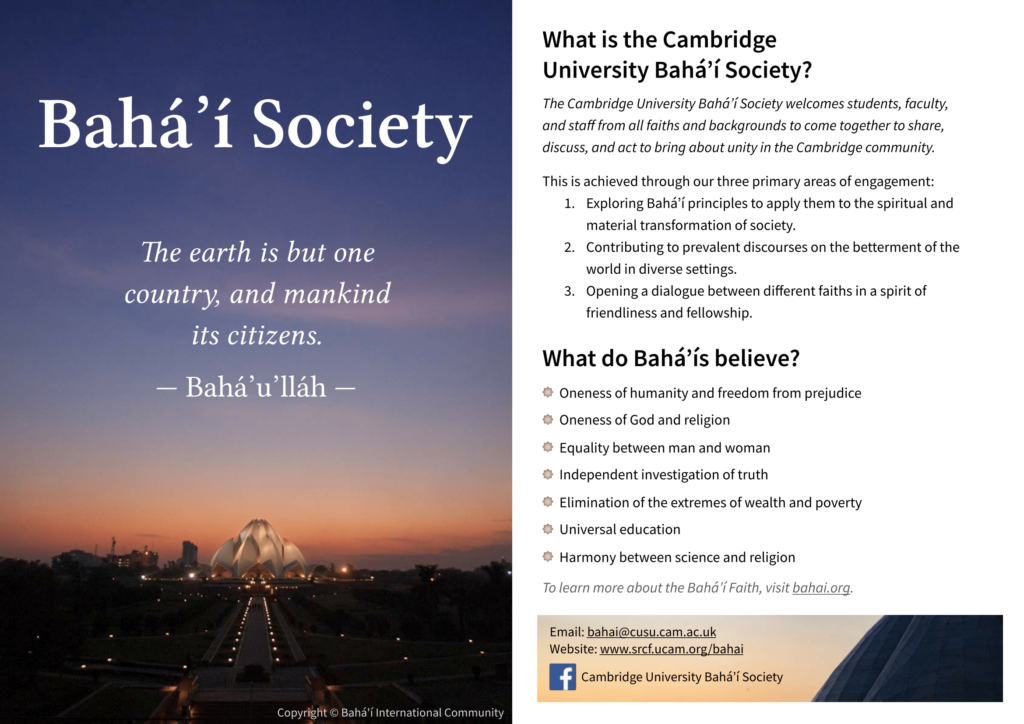
Organised by the Cambridge University Bahá’í Society.
An evening of poetry featuring works by three poets: Robert Hayden, American Poet Laureate and scholar of Black history and folklore, Mahvash Sabet, winner of the PEN Pinter Prize and International Writer of Courage, and Táhirih, 19th century Persian poetess and fearless champion of women’s emancipation. The poems of Táhirih were researched and published by Cambridge Professor and Pembroke College scholar Edward Granville Browne (1862-1926).
Short biographies will precede the poetry readings and there will also be time to discuss, reflect and mingle after the readings.
Organised by the Cambridge University Bahá’í Society.
Ongoing, accelerating and escalating global crises may lead some to despair. From an evolutionary perspective, however, this may not be just another random resurgence of trouble and conflict in the world: we may be experiencing birth pangs of the next phase in the unfolding of civilisation.
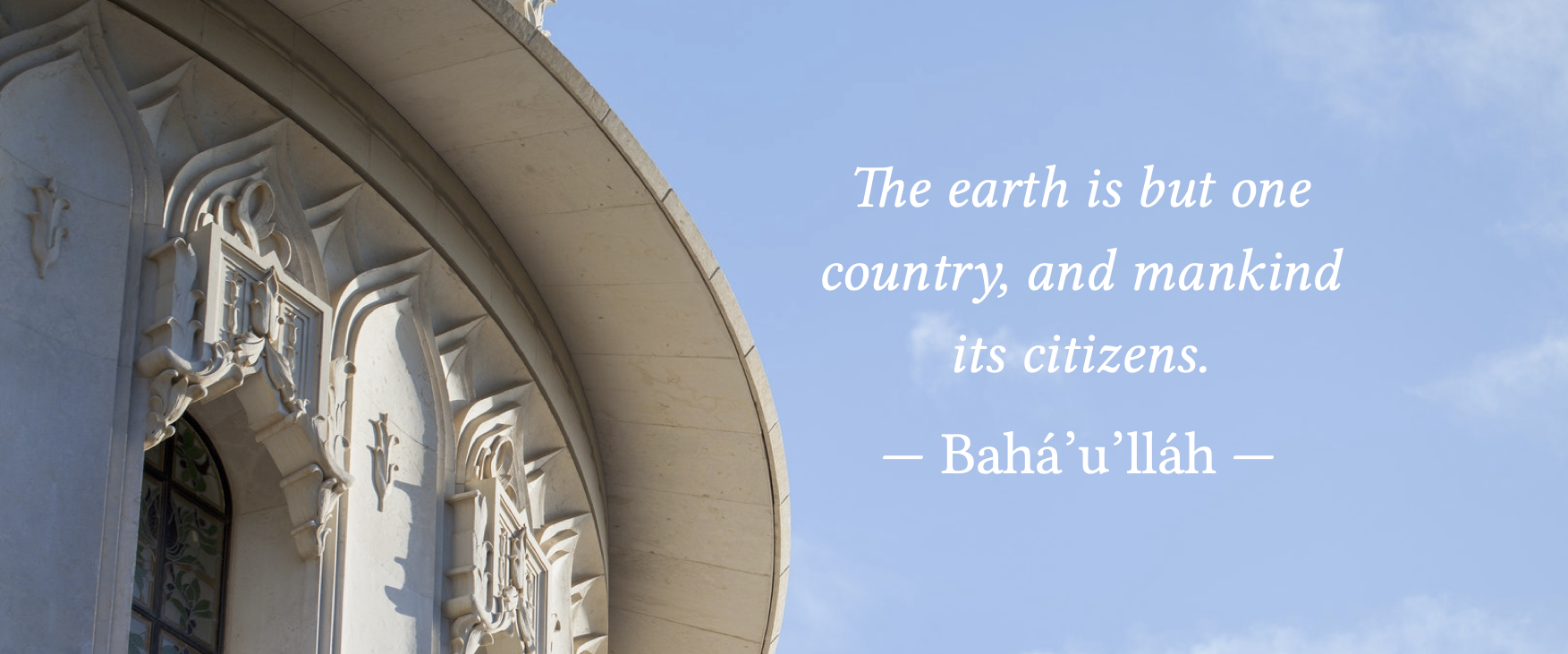
This period of intense transformation is ripe with occasions for genuine breakthrough as well as spectres of catastrophic breakdown. Humankind is becoming painfully aware of its essential interdependence and unity – learning, in profound and tangible ways, that “the earth is but one country, and mankind its citizens” (Bahá’u’lláh, circa 1880).
From simple bands of hunter-gatherers, our species has emerged, through increasing complexity and deepening cooperation, into tribal societies, city-states and nation-states. Now we stand at the threshold of an emerging world society and the possibility of global civilisation.
There is a fundamentally ethical dimension to this evolution: from primordial animalistic egoism and self-love, advancing towards various degrees of limited social altruism and loyalties, and now approaching the possibility of genuine universal coherence and belonging.
Alongside this ethical dimension, workings of an educational momentum can be seen: human potential would have remained dormant, unrealised, were it not for some form of active educational influence – left to mere ‘cumulative self-learning’, neither individual humans nor our collective species could have attained to their inherent potentialities.
The effects of this educational impulse run like a story line in the annals of history. Responding, though reluctantly, to the promptings of this momentum, peoples have progressively attained to the intellectual, moral and spiritual capacities that serve to civilise human character. Today, the opportunities offered by a profoundly global perspective give this age-long process entirely new dimensions and new meaning, opening civilisational prospects undreamt of in earlier ages.
Exploring this narrative of recurring social, ethical and spiritual education can help us to understand the dynamics of constructive and destructive forces in history.
Dr Partow Izadi explores these insights in a conversational session organised by the Cambridge University Bahá’í Society. Dr Izadi is a Senior Lecturer at the University of Lapland. His areas of expertise include systems theory, global education, evolution of civilisation and universal ethos.
United Nations projections show the global population reaching 11 billion and the world economy growing 500% by the end of this century. Can the planet accommodate 3 billion more people when our current ecological footprint already exceeds Earth’s biocapacity? This question will preoccupy humanity throughout this century, affecting everything we do from designing cities to producing food to using energy. Our mission is daunting. Somehow, we have to support 40% more people, raise billions out of poverty and reduce our ecological footprint to the sustainable level it was when we were just 4 billion. However, every facet of our social, economic and political order – indeed the totality of the dominant global culture – compels us to maintain the status quo. Clearly, we have to change direction.
Join Paul Hanley, journalist, author of the award-winning book ELEVEN and Bahá’í, as he considers how we got into this predicament and maps a way forward.
Paul is a recipient of the Canadian Environment Award, the Meewasin Conservation Award, the Saskatchewan Sustainability Award and the Rockefeller Foundation’s Food System Vision 2050 Prize. His book ELEVEN received the 2015 University of Saskatchewan President’s Award for Non-fiction. His biography Man of the Trees: Richard St Barbe Baker, the First Global Conservationist features an introduction by Jane Goodall and a foreword by HRH King Charles. He has published a total of six books and 1,600 articles on the environment, sustainable development, agriculture and other topics. Alongside his writing, Paul has extensive practical experience in organic gardening, living on an off-grid acreage in Saskatchewan for 10 years, and helping to build Saskatchewan’s organic farming movements.
Philosopher, Mystic, Social Reformer, Promulgator of Peace: ‘Abdu’l-Bahá (1844–1921) in Biography and Three Short Stories
“About the greatness of this man and his power no one who met him could entertain a doubt”, Professor E.G. Browne, Cambridge, 1890.
The speaker, Sean Hinton studied ethnomusicology at Cambridge University, served as Mongolia’s first honorary Consul-General in Australia, and is CEO of the Soros Economic Development Fund. He is joined by story tellers Tebogo Khutsoane, Sarah Percival and Ismael Velasco.
Climate Change, Global Pollution, Biodiversity: Can we Turn the Corner?
To overcome our environmental crises, we need to rethink our human purpose, our economy and our systems of governance, with young people in the lead.
Dr Arthur Dahl studied at Stanford University and worked as a senior official of UNEP. He was involved in drafting Agenda21 for the Rio Earth Summit and coordinated UN Earthwatch. He is president of the Baha’i-inspired International Environment Forum.
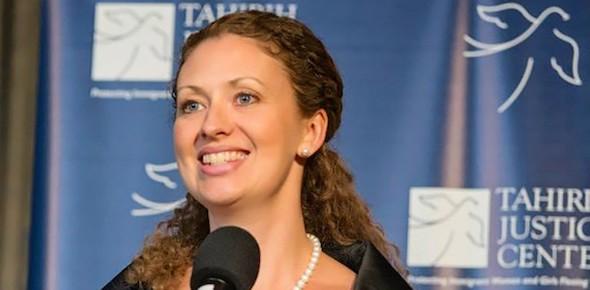
Layli Miller-Muro explores the revolutionary Baha’i concept of justice as a means to unity and how we can achieve it. Layli Miller-Muro is CEO of the Tahirih Justice Center, which provides free legal and social services and engages in advocacy on behalf of immigrant women and girls fleeing human rights abuses. Layli founded the organization in 1997 following her involvement as a law student in a high-profile case that set national precedent and revolutionized asylum law in the US.
Since 2001, Layli has led the Tahirih Justice Centre in its service to more than 27,000 women and children (https://www.tahirih.org). Prior to joining Tahirih, she was an attorney-advisor at the U.S. Department of Justice, Board of Immigration Appeals. Tahirih gained recognition for innovative use of pro bono services in the Stanford Social Innovation Review. She was listed in the Newsweek/Daily Beast 150 most fearless women. She is a frequent lecturer and has appeared in numerous news outlets including CNN, The New York Times, The Wall Street Journal, and The Washington Post. The talk will be followed by discussion.
Date/Time: 7:30pm-8:30pm on Wednesday, 31 March 2021
Talk will take place online (book free tickets through Eventbrite to receive link)
By late-September 2020 the Johns Hopkins Coronavirus Resource Center had tracked more than 33 million confirmed cases of the virus globally, causing close to 1 million deaths. The remarkable speed, global reach, and ease with which the virus crossed borders and is being transmitted between people has sent stock markets tumbling worldwide, with the World Bank projecting the deepest global recession since World War II. This excessive volatility, the sudden drop in confidence by consumers, and severe knock-on economic and social effects have resulted overnight in a swift contraction in cross-border finance, trade, air travel, and most other sectors of our interconnected global economy, as well as millions of job losses. This talk and discussion will examine measures to overhaul our system of global economic and social governance, both to respond to the immediate challenge of recovery from COVID-19 and to redouble efforts to advance the 2030 Agenda for Sustainable Development. The talk draws on the teachings of the Baha’i Faith.
Dr. Augusto Lopez-Claros is a Cambridge alumnus, and an international economist with over 30 years of experience in international organisations, including most recently the World Bank where he was director of the Global Indicators Group. Previously he was Chief Economist and Director of the Global Competitiveness Program at the World Economic Forum in Geneva, and Professor of Economics at the University of Chile. In May 2018, he was co-awarded the New Shape Prize for his work on Global Governance and has recently co-authored two books: ‘Equality for Women = Prosperity for All’ and ‘Global Governance and the Emergence of Global Institutions for the 21stCentury’ published by Cambridge University Press.
Date/Time: 8:00pm-9:00pm on Tuesday, 30 March 2021
Talk will take place online (book free tickets through Eventbrite to receive link)
Can positive impact and change at a local, national or even international level arise from our individual actions? Katina Jones challenges existing norms typically associated with our professional goals. Founder of the United Nations NGO Centre for Equality, and a group of organisations dedicated to health, education, philanthropy and human rights, she is in conversation with Jenifer Varzaly from the Cambridge University Baha’i Society. The discussion will explore topics related to meaningful work, personal drive and passion, and what each of us can do to make an impact in challenging times, whether large or small.
Date/Time: 12:00pm-1:00pm on Saturday, 27 March 2021
Talk will take place online (book free tickets through Eventbrite to receive link)
The Cambridge University Bahá’í society has organised two events this year as part of the University of Cambridge Festival of Ideas. Both events will take place on Saturday, 19 October 2019.
Educating for sustainable peace in a turbulent world
Saturday 19 October: 6:00pm – 7:00pm
University Centre, Granta Place Mill Lane, CB2 1RU
In a world increasingly destabilised by socio-political, economic and environmental conflict, is there hope for sustainable peace? A talk by Dr Sara Clarke-Habibi.
Dr Sara Clarke-Habibi has worked on peacebuilding in conflict-affected countries including Azerbaijan, Bosnia-Herzegovina, Colombia, Mexico and Cyprus. Drawing on education research, Dr Clarke-Habibi discusses how our understanding of the prerequisites of sustainable peace have changed over the last half-century in response to two global processes and links these insights to a Baha’i perspective on the future of the world.
Sara Clarke-Habibi researches on education in contexts of armed conflict, forced migration and mass violence. Sara holds a PhD in Education from the University of Cambridge (UK), an MA in Conflict Resolution from Landegg International University (Switzerland), and a BA in Ethics, Society and Law from the University of Toronto (Canada). She teaches on the intersection of education with issues of armed conflict, genocide, transitional justice, peacebuilding, social healing and reconciliation.
Organised by the Cambridge University Bahá’í Society for the University of Cambridge Festival of Ideas.
Change on the global stage: what makes an ‘International community’?
Saturday 19 October: 8:00pm – 9:00pm
University Centre, Granta Place Mill Lane, CB2 1RU
Global challenges call us to unprecedented new levels of international cooperation. Will we rise to the occasion?
Maja Groff is an international lawyer based in The Hague. She is a graduate of Harvard, Oxford and McGill Universities, and was a winner of the prestigious 2018 New Shape Prize for proposing global solutions to humanity’s problems. https://globalchallenges.org/our-work/the-new-shape-prize/awardees
Organised by the Cambridge University Bahá’í Society for the University of Cambridge Festival of Ideas.
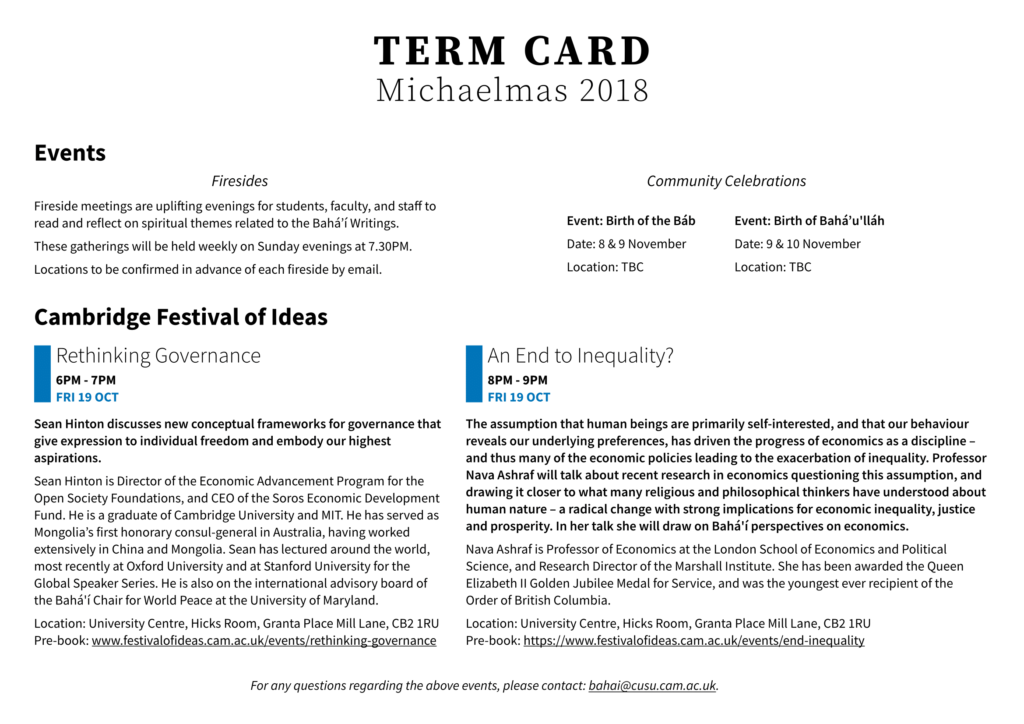
The Cambridge University Bahá’í society has organised two events this year as part of the Cambridge University Festival of Ideas. Both events will take place on Friday, 19 October 2018.
Rethinking Governance (6-7pm)
Sean Hinton discusses new conceptual frameworks for governance that give expression to individual freedom and embody our highest aspirations.
Sean Hinton is Director of the Economic Advancement Program for the Open Society Foundations, and CEO of the Soros Economic Development Fund. He is a graduate of Cambridge University and MIT. He has served as Mongolia’s first honorary consul-general in Australia, having worked extensively in China and Mongolia. Sean has lectured around the world, most recently at Oxford University and at Stanford University for the Global Speaker Series. He is also on the international advisory board of the Bahá’í Chair for World Peace at the University of Maryland.
An end to inequality? (8-9pm)
The assumption that human beings are primarily self-interested, and that our behaviour reveals our underlying preferences, has driven the progress of economics as a discipline – and thus many of the economic policies leading to the exacerbation of inequality. Professor Nava Ashraf will talk about recent research in economics questioning this assumption, and drawing it closer to what many religious and philosophical thinkers have understood about human nature – a radical change with strong implications for economic inequality, justice and prosperity. In her talk she will draw on Bahá’í perspectives on economics.
Nava Ashraf is Professor of Economics at the London School of Economics and Political Science, and Research Director of the Marshall Institute. She has been awarded the Queen Elizabeth II Golden Jubilee Medal for Service, and was the youngest ever recipient of the Order of British Columbia.